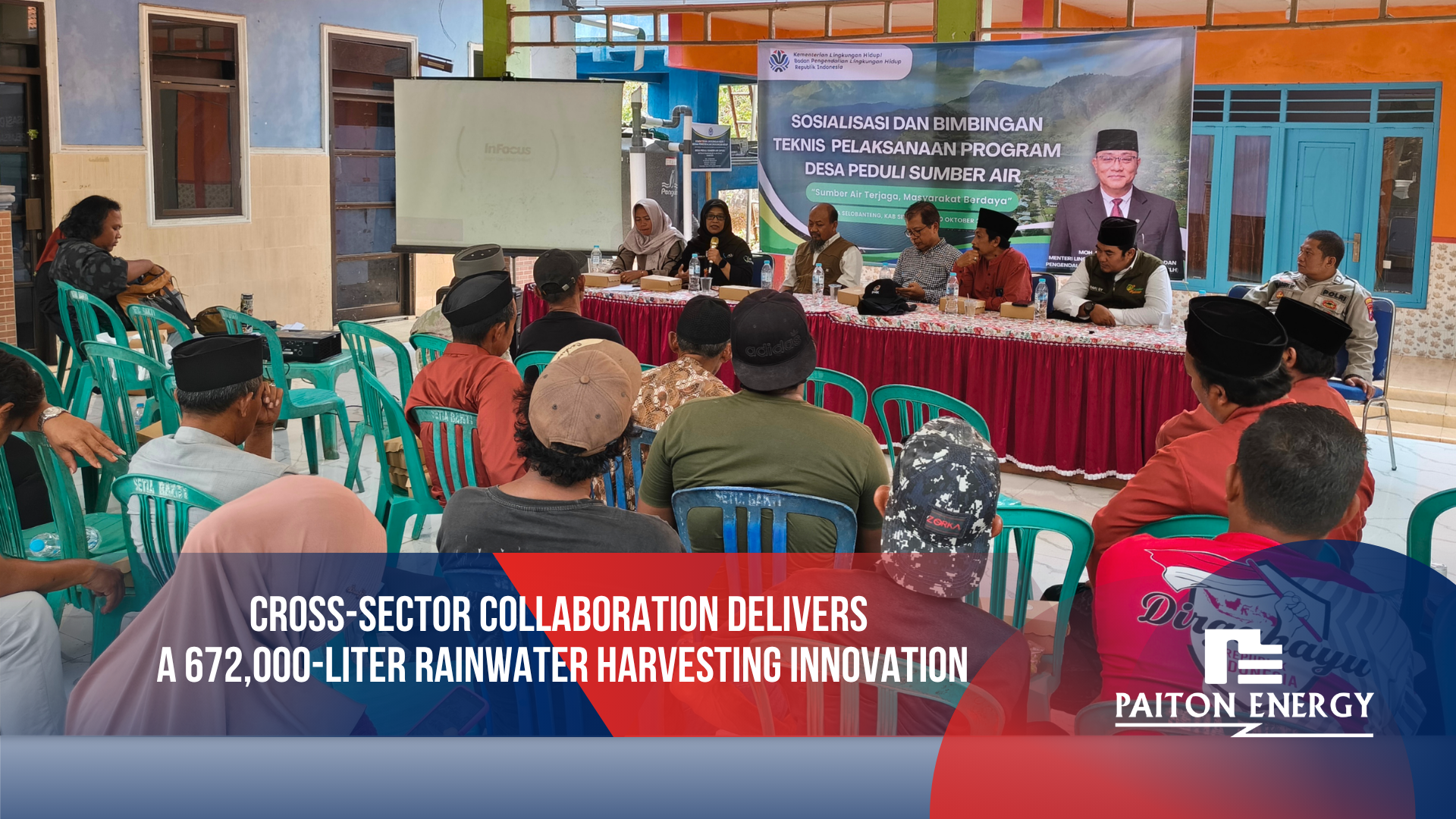
Situbondo, October 20, 2026 – Selobanteng Village in Banyuglugur District, Situbondo Regency, East Java, now has a stronger safeguard against the threat of prolonged drought. Through cross-sector collaboration, the village has integrated spring protection, water pipeline development, and a Rainwater Harvesting Installation, which collectively has the potential to capture and store approximately 672,000 liters of rainwater in a single rainy season.
The collaboration was initiated by the Directorate for the Protection and Management of Inland Water Ecosystems under the Ministry of Environment (KLH) through the Water Source Care Village (DPSA) Program, in partnership with PT Paiton Energy (www.paitonenergy.com), PT Paiton Operation & Maintenance Indonesia (POMI), Universitas Gadjah Mada (UGM), local government, and local community.
Paiton Energy – POMI’s involvement in this collaboration is integrated with the Protection of Springs and Biodiversity (PERMATA HATI) community development program. The program promotes an integrated environmental management approach by linking water source protection, strengthening vegetation cover, conserving biodiversity, and improving community access to water.
One of innovations developed by Paiton Energy – POMI to support rainwater utilization is the Rainwater Storage System (TAMPAN). The innovation repurposes the Company’s used Intermediate Bulk Container (IBC) tanks as rainwater storage units, with a capacity of approximately 4,000 to 6,000 liters per unit.
A TAMPAN unit with a capacity of 4,000 liters, assuming it is fully replenished once a week throughout the rainy season, has the potential to collect approximately 96,000 liters of rainwater. Consequently, the combined Rainwater Harvesting Installation (IPAH) and TAMPAN system can capture and store roughly 672,000 liters (672 cubic meters) of rainwater in a single rainy season.
Senior Forest Ecosystem Controller at the Ministry of KLH, Amin Sutanto, said that the program serves as a tangible example of how scientific knowledge, government policy, and private sector support can be integrated with local community needs.
According to Head of the Environmental Pollution and Damage Control Division at the Situbondo DLH, Ranti Seta Ayu Pratiwi, rainwater storage facilities have now been installed at 13 locations. “Thanks to the support provided by Paiton Energy – POMI, as well as assistance from the Ministry of Environment, residents of Selobanteng Village have already experienced a positive change, namely easier access to water,” she said.
Meanwhile, Head of External Relations of PT Paiton Energy, Bambang Jiwantoro, stated that the Company’s involvement is part of the integrated Protection of Springs and Biodiversity (PERMATA HATI) program, which has been implemented in Selobanteng since 2009.
According to Professor of Water Resources Engineering at UGM, Prof. Agus Maryono, the key to the success of this drought mitigation initiative lies in technological adaptation. The implementation of rainwater harvesting systems and infiltration wells in Selobanteng Village has been tailored to the area’s soil characteristics and residents’ domestic needs, ensuring that rainwater is not wasted but instead infiltrates back into the ground or is stored as a reserve for the dry season.
In addition to rainwater harvesting infrastructure, the collaboration also extends to upstream conservation efforts through the planting of water-retaining vegetation and fruit trees around water catchment areas, as well as the development of a pipeline network to deliver water directly to residential communities. To ensure the program’s sustainability, local residents are actively involved in the construction and maintenance of the facilities, fostering a strong sense of ownership and responsibility.
The head of Selobanteng Village, Muttaha, expressed optimism about the changes taking place in the community. “For years, Selobanteng Village has faced recurring droughts and challenges in accessing clean water. For our residents, rainwater harvesting is a new concept that has opened our eyes to new possibilities. Now, the community has more options to cope with prolonged dry seasons, and we hope that in the future there will be no more complaints about water scarcity,” he said.
According to Head of Human Capital, Facility, and Community of PT POMI Rochman Hidayat, Paiton Energy-POMI is committed to supporting community empowerment through an integrated approach, ranging from spring protection and the development of supporting infrastructure to community education and capacity building. “The company hopes that local communities can become the primary actors in safeguarding the sustainability of water resources in their respective areas,” he said.
The Selobanteng collaboration demonstrates how a transdisciplinary approach can be applied in practice. Academic expertise, government support, private sector contributions through CSR programs, and local community knowledge have been integrated to develop a complementary water management system. The synergy between the Water Source Care Village (DPSA) Program and the Protection of Springs and Biodiversity (PERMATA HATI) Program also illustrates how government initiatives and corporate community development programs can work hand in hand to address environmental and community needs.
In managing its CSR, PT Paiton Energy and POMI consistently applies a multi-stakeholder synergy approach, a collaborative effort involving key components: the government, the community, academia, business entities, and the media. These five elements are consistently engaged in every CSR and ESG program conducted by the Company.
PT Paiton Energy is the first and one of the largest Independent Power Producers (IPPs) operating in Indonesia. The shareholders of the Company consist of Medco Daya Energi Sentosa (Medco Group) as the majority shareholder, RATCH Group, and Nebras Power.
MDES is part of the Medco Group. In the energy sector, Medco Group plays a crucial role as a primary provider of oil and gas as well as clean electricity to strengthen a reliable, efficient, and sustainable national energy security and independence. Medco Group consistently plays an active role in supporting the achievement of the Sustainable Development Goals (SDGs).