Have you ever wondered, when night falls and you press the light switch in your bedroom, how electricity travels to the light fixture and becomes a source of illumination? We often take the presence of electrical energy in our homes for granted, without realizing the long and complex journey that these electrons must undertake.
The national electricity system operates through three highly structured primary stages, starting from large-scale generation facilities, flowing through giant transmission networks, and ultimately reaching household installations. In Indonesia—particularly within the Java-Bali electricity system—the integration of infrastructure across various power plants and interconnected network systems is massive and relied upon to power the daily activities of millions of residents.
Generation: Converting Primary Energy into Electrical Energy
The first stage of this long journey begins at major power generation facilities. One example of a vital facility that plays a crucial role in supplying energy demands is the Steam Power Plant (PLTU).
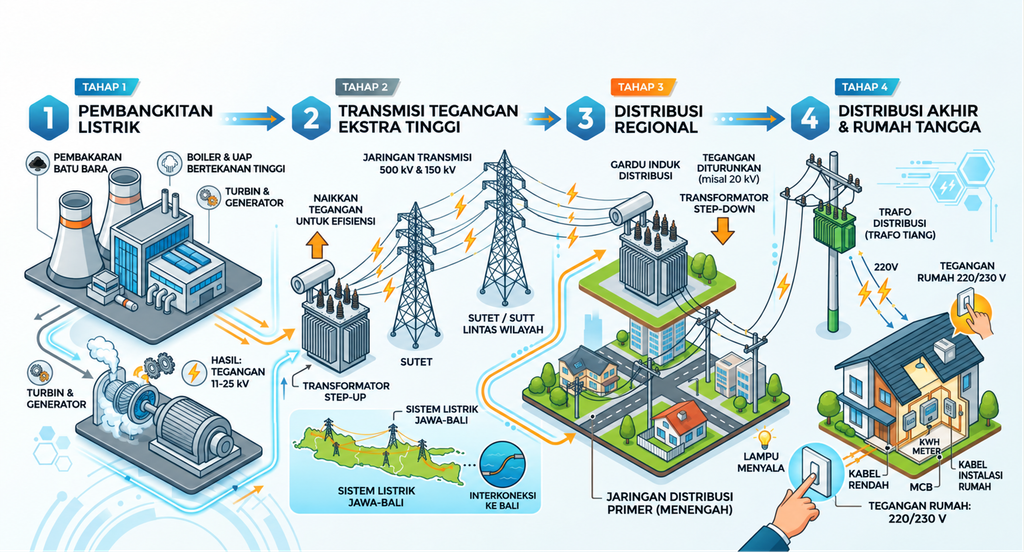
At facilities such as PLTU Paiton, located in East Java, the primary energy conversion process heavily relies on coal. Coal is burned inside a boiler to heat water until it turns into high-pressure steam. This high-pressure hot steam is then directed to spin turbine blades directly connected to a large generator. Inside the generator, the mechanical energy from the turbine rotation is converted into alternating current (AC) electrical energy.
The output voltage from the generator is typically not high enough, so it is stepped up via a step-up transformer to ensure much more efficient transmission across distances spanning hundreds of kilometers to various cities on the island of Java. Consequently, the operations of PLTU Paiton are closely integrated and connected with the Java-Bali electricity system, supplying energy to the interconnection network alongside other power plants.
Transmission: The Interregional Energy “Highway”
Upon exiting the generator at tens of thousands of volts, the electricity must have its voltage increased through a step-up transformer before entering the transmission network. This voltage increase aims to minimize power losses (energy dissipation) caused by wire resistance during long-distance travel. This energy is then transmitted via Extra-High Voltage Overhead Power Lines (SUTET) and High Voltage Overhead Power Lines (SUTT).
In our operational region, the Java electrical network is supported by a transmission backbone consisting of 500 kV SUTET and 150 kV networks connecting various regions. The existence of this interconnection network enables large-scale power plants like PLTU Paiton not only to supply local demands in East Java, but also to transmit power across other regions, even connecting to Bali via submarine cables. Through the Java PLTU interconnection system, regional energy supply stability is continuously maintained.
Distribution: Delivering Electricity to the Pole Outside Your Home
After traveling hundreds of kilometers across the island, the high-voltage electric current arrives at a distribution substation located near urban areas or residential neighborhoods. At this substation, the voltage is gradually reduced through step-down transformers before entering the distribution network.
The distribution stage is divided into two main parts: the medium-voltage primary distribution network (typically around 20 kV in many PLN operational areas) surrounding urban districts, and the secondary distribution network. This secondary network utilizes distribution transformers—commonly known as pole-mounted transformers—to further reduce the voltage to 220/380 volts.
This voltage is then distributed via low-voltage cables on utility poles outside homes, passing through the kWh meter, through the Miniature Circuit Breaker (MCB) panel inside your home, and finally standing ready for deployment whenever you flip a switch or plug a device into an electrical outlet.
The Concrete Flow of Electricity’s Journey: From the Plant to Your Home Switch
As a comprehensive, easily understood illustration, let us break down the concrete flow of energy journeying to our homes:
- Coal is burned inside the PLTU boiler to produce steam that spins the turbine and drives the generator.
- The generated electrical voltage is then stepped up at the power plant to prepare it for entry into the 500 kV / 150 kV transmission network within the Java electrical system.
- Electricity flows rapidly through regional SUTET and SUTT networks, ensuring supply reliability from the giant PLTU to load centers across various cities.
- Upon arrival at the regional substation, the voltage is stepped down to the 20 kV primary network before being forwarded to distribution transformers located near residential communities.
- From the pole-mounted transformer, electric current at a standard 220/230 volts is delivered to the home, passes through the kWh meter, enters the household panel, and terminates at the switch you press every day to turn on the lights.
By understanding the complexity and reliability of the Java PLTU infrastructure alongside its distribution network, we gain a deeper appreciation that every watt of energy we consume involves large-scale technological cooperation operating tirelessly behind the scenes.