The strengthening of village economies serves as the primary pillar in achieving inclusive and sustainable community welfare, particularly within the Probolinggo and Situbondo Regency areas.
As part of its long-term commitment, PT Paiton Energy views rural economic activity as a vital driver that must be accelerated through integrated innovation and empowerment.
In addressing structural challenges such as extreme poverty and stunting, the company has designed the Paiton Energy 2030 vision.
This program does not merely focus on transient assistance; rather, it aims to create an independent ecosystem where the village economy can grow resiliently, grounded in local potential managed professionally and sustainably for all citizens.
Social Transformation: Addressing Stunting and Extreme Poverty
One of the most significant challenges in Probolinggo Regency is the stunting rate, which reached a prevalence of 35.4% at the beginning of 2024. Although there has been a significant reduction to 10.8%, PT Paiton Energy recognizes that health is the foundation of productivity.
Without healthy human resources, it is impossible for rural economic activities to develop optimally.
Through the Paiton Energy 2030 program, interventions are conducted holistically. The company integrates nutritional literacy with family economic empowerment. Families at risk of stunting are provided with in-depth education regarding child development and nutritional sources derived from local food products.
Community-based economic empowerment ensures that resilient community groups gain easier access to quality nutrition, which systematically reinforces the economic endurance of the village.
Regional Resilience: Disaster Mitigation and Environmental Adaptation
The operational areas in eastern East Java are highly vulnerable to hydrometeorological disasters, such as floods, landslides, and droughts. In accordance with Law No. 24 of 2007, PT Paiton Energy is developing mitigation systems that involve the community as the primary actors.
Environmental security is directly correlated with the financial stability of residents. If agricultural land is damaged by floods or landslides, livelihoods are disrupted. Consequently, the company promotes:
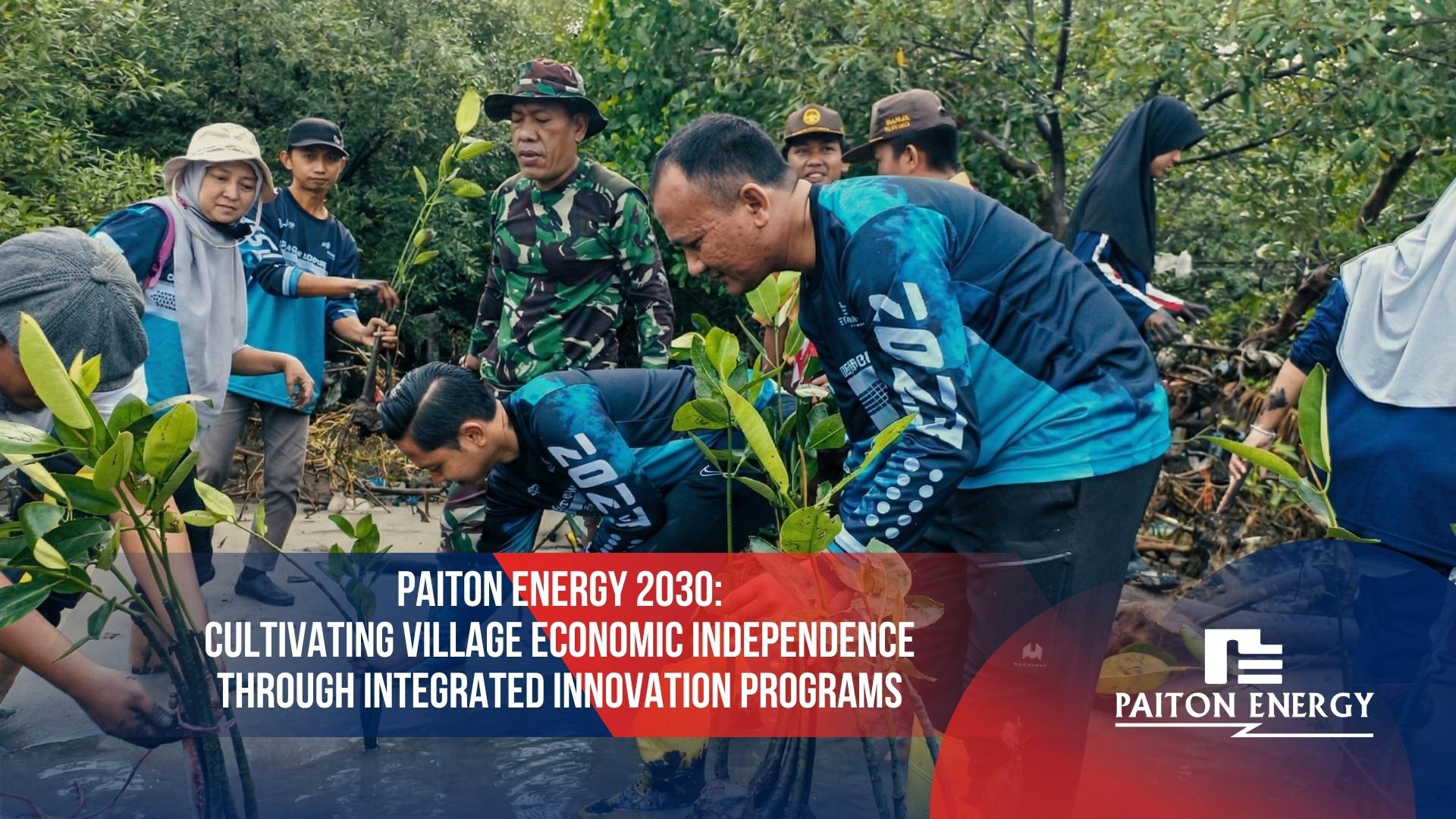
- Restoration of Degraded Land: Minimizing landslides and flooding during the rainy season.
- Integrated Waste Management: Reducing greenhouse gas emissions in line with the Indonesia Emas 2045 targets through circular waste processing.
- Early Warning Systems: Building community capacity for disaster preparedness without paralyzing their ability to maintain livelihoods.
Energy Innovation and Human Resource Digitalization
As an energy producer, PT Paiton Energy fully supports the Net Zero Emission 2060 target. A concrete step in this direction is encouraging the use of clean energy at the village level.
The abundant potential of biomass and solar energy in Probolinggo has not yet been optimally utilized due to infrastructure and skill constraints.
Paiton Energy has initiated vocational training for local youth to master clean energy technologies. This measure ensures that rural economic activities are based on sustainable and modern technology.
Furthermore, digital literacy is being strengthened to bridge the gap, considering that 45.22% of the workforce currently operates in the low-productivity informal sector. With digital skills, village MSME products can reach broader markets.
Tourism Villages and Agro-industry: New Hubs of Growth
The Probolinggo Regency Government has designated several tourism villages, such as Guyangan and Ranu Segaran, as priorities. PT Paiton Energy aligns its Social and Environmental Responsibility (TJSL) programs to develop “Thematic Villages.”
In these areas, rural economic activity is a combination of local wisdom, tourism, and agro-industry.
Developing tourism villages involves more than just natural scenery; it requires infrastructure readiness and professional management. The company provides mentoring for village tourism managers to create value-added products from local resources, thereby reducing dependence on vulnerable traditional sectors.
Synergy Towards Sustainable Independence
The success of the Paiton Energy 2030 program relies heavily on cross-sector collaboration. Utilizing the principles of Capacity Building and Empowerment, PT Paiton Energy ensures that every intervention has a clear exit strategy.
The objective is that by 2030, the communities in Probolinggo and Situbondo will no longer depend on charitable aid but will instead stand firm on economic systems they have built themselves.
The integration of clean energy utilization, environmental conservation, and digital skill enhancement will ensure that the village economy becomes a robust pillar of national resilience. The company believes that true independence is achieved when a community can manage its risks and maximize its potential autonomously.
In conclusion, strengthening rural economic activity is the key to eradicating extreme poverty and creating a brighter future for the next generation surrounding the company’s operational areas.