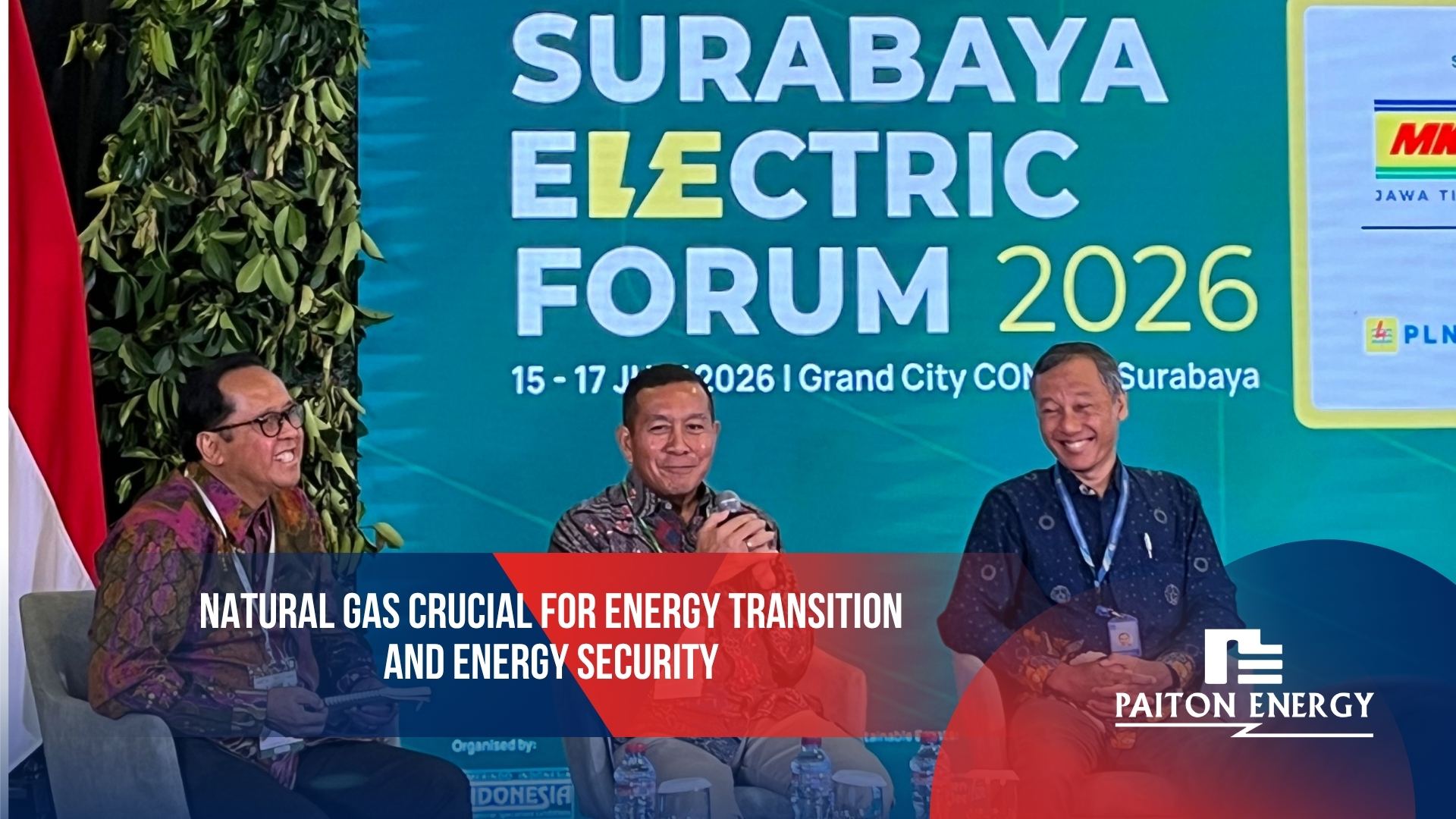
Surabaya, July 16, 2026 – President Director of PT Paiton Energy (www.paitonenergy.com), Fazil Erwin Alfitri, stated that natural gas plays a crucial role in securing energy supply and bridging the transition to 100% renewable energy utilization to achieve Net Zero Emission (NZE) by 2060, as well as maintaining national energy security.
“In the transition journey toward clean energy, there must be a bridge before reaching 100% renewable energy utilization. In this regard, natural gas holds a strong position as a transition bridge. On one hand, its emissions are lower than coal, and on the other hand, the supply or price is relatively more moderate compared to shifting immediately to 100% renewables,” said Fazil.
This was elaborated by Fazil Erwin Alfitri while serving as a speaker in a scientific session titled, “Strategies for Accelerating Energy Transition Through Clean Energy (PLTG/PLTGU),” held in Surabaya, East Java, on Thursday (16/7).
According to Fazil, a major challenge for Indonesia’s electricity sector is managing structural demand growth aligned with national economic growth ambitions. Referring to the 2025–2034 RUPTL target, Indonesia requires an additional new generation capacity of 69.5 GW by 2034 to keep pace with the rate of industrialization and urbanization.
Amidst these massive energy demands, Paiton Energy sees the need for a well-calculated balance across the Energy Trilemma aspects, which entail simultaneously maintaining environmental sustainability, tariff affordability, and security of supply. In this context, the Combined Cycle Power Plant (PLTGU) is considered to play a crucial role as a clean energy bridge.
Combined Cycle Power Plants (PLTGU) achieve a highly advanced thermal efficiency of up to 60% and are capable of reducing CO₂ emissions by up to 50% compared to coal-fired power plants (PLTU). The flexible characteristics of gas turbines, coupled with their fast-ramping capability (~10 MW/minute), make them the most ideal dispatchable power source to manage the intermittency stability of renewable energy plants, such as solar and wind, within the Java-Bali transmission grid.
Based on operational modeling, the integration of Combined Cycle Power Plant (CCPP) technology has the potential to significantly reduce average CO₂ emission intensity by up to 34% through enhanced plant thermal efficiency.
This emission reduction potential can be further optimized to gradually reach up to 51%, aligned with the future readiness of the technological ecosystem for clean fuel co-firing utilizing ammonia in coal-fired power plants (PLTU) and hydrogen in combined cycle power plants (PLTGU).
Fazil emphasized that the energy transition toward 100% renewable energy aligned with the NZE target requires close collaboration from all stakeholders. Therefore, the implementation of a solid Pentahelix collaboration becomes highly essential.
PT Paiton Energy believes that accelerating investments in green energy infrastructure within high-potential regions like East Java can only be optimally realized through sustainable synergy among the government, industry players, academia, financial institutions, and the broader community.
PT Paiton Energy is the first and one of the largest Independent Power Producer (IPP) operating in Indonesia. The shareholders of the Company consist of Medco Daya Energi Sentosa (MDES) as the majority shareholder, RATCH Group, and Nebras Power.